All content on this site is intended for healthcare professionals only. By acknowledging this message and accessing the information on this website you are confirming that you are a healthcare professional. If you are a patient or carer, please visit Know AML.
The AML Hub website uses a third-party service provided by Google that dynamically translates web content. Translations are machine generated, so may not be an exact or complete translation, and the AML Hub cannot guarantee the accuracy of translated content. The AML Hub and its employees will not be liable for any direct, indirect, or consequential damages (even if foreseeable) resulting from use of the Google Translate feature. For further support with Google Translate, visit Google Translate Help.


The AML Hub is an independent medical education platform, sponsored by Daiichi Sankyo, Kura Oncology, Syndax, Abbvie, Thermo Fisher and Johnson & Johnson. Funders are allowed no direct influence on our content. The levels of sponsorship listed are reflective of the amount of funding given. View funders.
Now you can support HCPs in making informed decisions for their patients
Your contribution helps us continuously deliver expertly curated content to HCPs worldwide. You will also have the opportunity to make a content suggestion for consideration and receive updates on the impact contributions are making to our content.
Find out more
Create an account to access:
Bookmark & personalize site content
Receive alerts for new content in your areas of interest
View AML content recommended for you
The role of combination strategies in the treatment of FLT3-mutated acute myeloid leukemia
 Agnieszka Wierzbowska
 Charles Craddock
 Roland Walter
 Jorge Sierra
 Lars Bullinger
 Gail J. Roboz
Do you know... Which of the following best describes the current place of FLT3 inhibitor-based combination strategies in FLT3m AML?
During the latest AML Hub Steering Committee Meeting on August 11, 2026, key opinion leaders met to discuss the role of combination strategies in the treatment of FLT3-mutated (FLT3m) acute myeloid leukemia (AML). The meeting opened with a presentation by Gail J. Roboz, followed by a discussion featuring Agnieszka Wierzbowska, Charles Craddock, Jorge Sierra, Lars Bullinger, and Roland Walter.
The role of combination strategies in the treatment of FLT3-mutated acute myeloid leukemia
The role of combination strategies in the treatment of FLT3-mutated acute myeloid leukemia
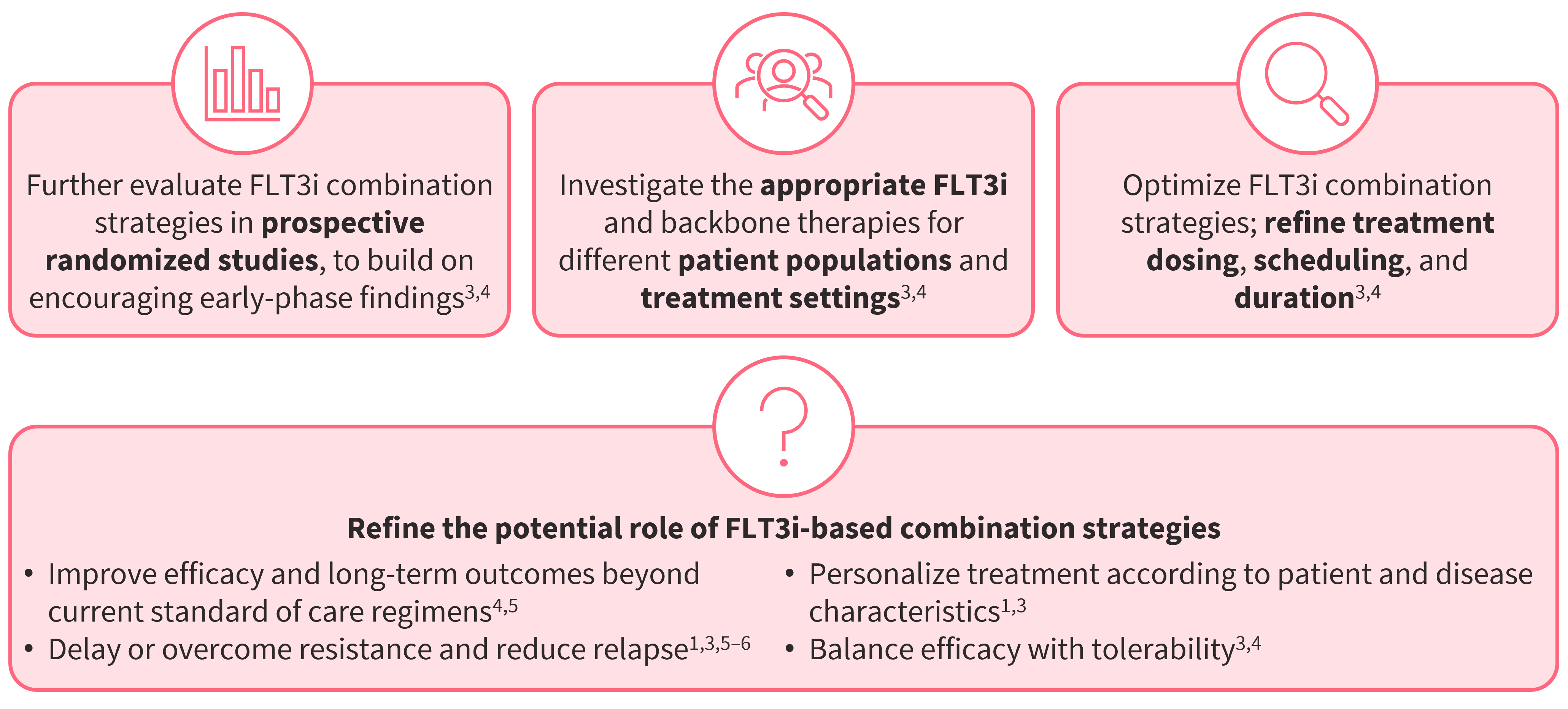
Roboz reviews the rationale for combination strategies in FLT3m AML (Figure 1),1,2 and discusses updates presented at the 2026 American Society of Clinical Oncology (ASCO) Annual Meeting, May 29 – June 2, 2026, Chicago, US, and the European Hematology Association (EHA) 2026 Congress, June 11–14, 2026, Stockholm, SE. She considers potential future directions for FLT3 inhibitor-based combination strategies (Figure 2),1,3–6 followed by a discussion focused on how best to translate high remission rates into durable disease control and long-term outcomes. The steering committee also explores how treatment strategies may need to be individualized according to patient fitness, molecular profile, treatment response, and access to available therapies.
Figure 1. Rationale for FLT3 inhibitor-based combination strategies*
.png)
Figure 2. Future directions for combination strategies in FLT3m AML*
Key points
- FLT3 inhibitors are an integral component of treatment for patients with FLT3m AML, with combination strategies being evaluated across intensive and less-intensive treatment settings and in both newly diagnosed (ND) and relapsed/refractory (R/R) disease.3
- Early-phase studies of FLT3 inhibitor-based combinations have demonstrated clinical activity in patients with FLT3m AML who are unfit for intensive chemotherapy, supporting continued investigation of triplet and other combination approaches in this setting.2
- In the phase I/II VICEROY trial (NCT05520567) composite complete remission (CRc) rates of up to 91% were achieved with gilteritinib + venetoclax + azacitidine in older/unfit patients with ND FLT3m AML (N = 43).2
- Recent data continue to expand the evidence base for FLT3 inhibitor combinations, with updates across different treatment settings presented at the 2026 ASCO Annual Meeting and EHA2026 Congress; these included combinations with venetoclax-based therapy and intensive chemotherapy in ND and R/R FLT3m AML.
- Results from a phase I/II trial (NCT03661307) of quizartinib + decitabine + venetoclax demonstrated complete remission (CR) rates of 91% and 61% in patients with ND (n = 42) or R/R (n = 46) FLT3-internal tandem duplication (ITD) AML.7,8
- In a retrospective comparison of intensive chemotherapy (IC) in combination with quizartinib (n = 88) vs midostaurin (n = 127) in patients with ND FLT3-ITD AML, improved remission and survival rates were observed with the quizartinib combination strategy vs midostaurin (CRc, 85.2% vs 73.2%; 1-year overall survival [OS], 93% vs 78%; 1-year event-free survival [EFS], 77% vs 56%).9
- In the phase III HOVON 156 trial (NCT04027309), comparable OS rates were demonstrated with gilteritinib + IC (n = 384) vs midostaurin + IC (n = 384) in patients with ND FLT3m AML; median OS was not reached at the 43-month follow-up.10
- Preliminary results from a phase I/II trial investigating the combination of gilteritinib + momelotinib in patients with R/R FLT3m AML demonstrated encouraging initial clinical activity, with a CRc rate of 23%.11
- Different FLT3 inhibitors and treatment approaches cannot be directly compared based on response or survival outcomes alone, as trial populations, FLT3 mutation subtype, age, treatment backbone, and transplant strategies may differ substantially.
- For fit patients with FLT3m AML, FLT3 inhibitor-based intensive chemotherapy followed by consideration of allogeneic hematopoietic stem cell transplantation (allo-HSCT) remains an important treatment strategy, although approaches vary across countries and individual patients.12
- Measurable residual disease (MRD) is increasingly relevant to treatment decisions in FLT3m AML, with the potential to help identify patients at differing risks of relapse and inform decisions around transplantation and subsequent treatment; however, the optimal role and timing of MRD-guided strategies remain areas of investigation.13
- The potential role of FLT3 inhibitors as maintenance therapy warrants further evaluation, including following intensive chemotherapy or allo-HSCT, with prospective randomized studies needed to establish their role and identify patients most likely to benefit.14
- Achieving remission is an important treatment goal, but remission rates alone may not capture the longer-term value of a treatment strategy in AML. Greater emphasis on deeper responses, including MRD-negative CR, together with survival data, may provide a more comprehensive assessment of treatment benefit.15,16
- Further prospective randomized studies are needed to define the role of FLT3 inhibitor-based combinations, including the most appropriate FLT3 inhibitor and treatment backbone for different patient populations and settings, as well as optimal dosing, scheduling, and treatment duration; improving long-term outcomes while balancing efficacy and tolerability and addressing resistance and relapse remain key objectives.17
- The choice between treatment pathways extends beyond achieving an initial remission, with transplantation, MRD monitoring, maintenance, and management of relapse all potentially forming part of an individualized long-term treatment strategy; the optimal approach depends on patient characteristics, molecular response, and availability of therapies.15–17
This educational activity is independently supported by Daiichi Sankyo. All content is developed by SES in collaboration with an expert steering committee. Funders are allowed no influence.
References
- Abdel-Aziz AK, Dokla E, Saadeldin MK, et al. FLT3 inhibitors and novel therapeutic strategies to reverse AML resistance: an updated comprehensive review. Crit Rev Oncol Hematol. 2023;191:104139. DOI: 10.1016/j.critrevonc.2023.104139
- Altman JK, Perl A, Wang E, et al. Venetoclax (VEN) and azacitidine (AZA) with gilteritinib (GILT) in patients with newly diagnosed (ND) FLT3mut+ acute myeloid leukemia (AML) ineligible for intensive induction chemotherapy (chemo): Interim results from the phase 1/2 VICEROY study. Blood. 2025;146(Suppl 1):654. DOI: 10.1182/blood-2025-654
- Atluri H, Abaza Y, Altman JK. Targeted triplet therapies incorporating FLT3 or IDH inhibitors: ready for prime time? Hematology Am Soc Hematol Educ Program. 2025;2025(1):592-598. DOI: 10.1182/hematology.2025000754
- Jen W-Y, Lachowiez CA, Marvin-Peek J, et al. Optimizing lower intensity triplet therapy in acute myeloid leukemia: a practical guide. Blood Cancer J. 2025;16(1):6. DOI: 10.1038/s41408-025-01429-z
- Leifheit ME, Johnson G, Kuzel TM, et al. Enhancing therapeutic efficacy of FLT3 inhibitors with combination therapy for treatment of acute myeloid leukemia. Int J Mol Sci. 2024;25(17):9448. DOI: 10.3390/ijms25179448
- Kennedy VE, Smith CC. FLT3 targeting in the modern era: from clonal selection to combination therapies. Int J Hematol. 2024;120(5):528-540. DOI: 10.1007/s12185-023-03681-0
- Yilmaz M, Muftuoglu M, Kantarjian H, et al. Quizartinib in combination with decitabine and venetoclax in FLT3-mutated AML. Oral Abstract #6504. Presented at: 2026 American Society of Clinical Oncology Annual Meeting; May 29 – Jun 2, 2026; Chicago, US.
- Yilmaz M, Muftuoglu M, DiNardo C, et al. Triplet therapy with quizartinib, decitabine, and venetoclax in FLT3-ITD AML. Poster #PF509. Presented at: European Hematology Association 2026 Congress; Jun 11–14, 2026; Stockholm, SE.
- Lee MH, Tramontano AC, Lin C, et al. Intensive chemotherapy in combination with quizartinib versus midostaurin for FLT3-ITD mutated acute myeloid leukemia: A multicenter cohort study. Oral Abstract #S133. Presented at: European Hematology Association 2026 Congress; Jun 11–14, 2026; Stockholm, SE.
- Raaijmakers MHGP, Ossenkoppele GJ, Gradowska PL, et al. Gilteritinib versus midostaurin in patients with newly diagnosed FLT3-mutated acute myeloid leukemia eligible for intensive therapy: Results from the phase 3 HOVON156/AMLSG28-18/PASHA trial. Oral Abstract #LB5005. Presented at: European Hematology Association 2026 Congress; Jun 11–14, 2026; Stockholm, SE.
- Campoverde L, Hachem M, Ravandi-Kashani F, et al. A phase I/II study of gilteritinib and momelotinib in adults with relapsed or refractory FLT3-mutated acute myeloid leukemia. Poster #PF550. Presented at: European Hematology Association 2026 Congress; Jun 11–14, 2026; Stockholm, SE.
- Schlenk RF, Montesinos P, Kim H-J, et al. Impact of hematopoietic cell transplantation and quizartinib in newly diagnosed patients with acute myeloid leukemia and FMS-like tyrosine kinase 3-internal tandem duplications in the QuANTUM-First trial. Haematologica. 2025;110(9):2024-2039. DOI: 10.3324/haematol.2024.286623
- Sanz J, Bug G, Ciceri F, et al. Measurable residual disease-guided interventions in patients with acute myeloid leukaemia undergoing allogeneic haematopoietic cell transplantation: Best practice recommendations from the European Society for Blood and Marrow Transplantation Practice Harmonisation and Guidelines Committee. Lancet Oncol. 2025;26(11):e586-e596. DOI: 0.1016/S1470-2045(25)00426-7
- Sweet K, Cluzeau T. Clinical perspectives on post-induction maintenance therapy in patients with acute myeloid leukaemia in remission who are ineligible for allogeneic haematopoietic stem cell transplantation. Br J Haematol. 2025;206(1):61-68. DOI: 10.1111/bjh.19924
- Hourigan CS. Achieving MRD negativity in AML: How important is this and how do we get there? Hematology Am Soc Hematol Educ Program. 2022;2022(1):9-14. DOI: 10.1182/hematology.2022000323
- Shallis RM, Pollyea DA, Zeidan AM. The complete story of less than complete responses: The evolution and application of acute myeloid leukemia clinical responses. Blood Rev. 2021;48:100806. DOI: 10.1016/j.blre.2021.100806
- Short NJ, Kantarjian H, Ravandi F, et al. Emerging treatment paradigms with FLT3 inhibitors in acute myeloid leukemia. Ther Adv Hematol. 2019;10:2040620719827310. DOI: 10.1177/2040620719827310
Please indicate your level of agreement with the following statements:
The content was clear and easy to understand
The content addressed the learning objectives
The content was relevant to my practice
I will change my clinical practice as a result of this content
This content is accurate as of the date of publication and is not updated retrospectively. Please refer to the latest available evidence, guidelines, and relevant regulatory information when making clinical decisions.