All content on this site is intended for healthcare professionals only. By acknowledging this message and accessing the information on this website you are confirming that you are a healthcare professional. If you are a patient or carer, please visit Know AML.
The AML Hub website uses a third-party service provided by Google that dynamically translates web content. Translations are machine generated, so may not be an exact or complete translation, and the AML Hub cannot guarantee the accuracy of translated content. The AML Hub and its employees will not be liable for any direct, indirect, or consequential damages (even if foreseeable) resulting from use of the Google Translate feature. For further support with Google Translate, visit Google Translate Help.


The AML Hub is an independent medical education platform, sponsored by Daiichi Sankyo, Kura Oncology, Syndax, Abbvie, Thermo Fisher and Johnson & Johnson. Funders are allowed no direct influence on our content. The levels of sponsorship listed are reflective of the amount of funding given. View funders.
Now you can support HCPs in making informed decisions for their patients
Your contribution helps us continuously deliver expertly curated content to HCPs worldwide. You will also have the opportunity to make a content suggestion for consideration and receive updates on the impact contributions are making to our content.
Find out more
Create an account to access:
Bookmark & personalize site content
Receive alerts for new content in your areas of interest
View AML content recommended for you
Targeting menin: A paradigm shift in acute myeloid leukemia therapy
 Charles Craddock
 Selina Luger
 Lars Bullinger
 Gail J. Roboz
 Joshua Zeidner
Do you know... Multiple randomized, phase III, placebo-controlled trials are investigating menin inhibitor-based therapies in which of the following settings?
During the AML Hub Steering Committee Meeting on August 11, 2026, key opinion leaders met to discuss the role of menin inhibitors in the evolving treatment paradigm for patients with acute myeloid leukemia (AML). The meeting opened with a presentation by Joshua Zeidner, followed by a panel discussion featuring Gail Roboz, Charles Craddock, Selina Luger, and Lars Bullinger.
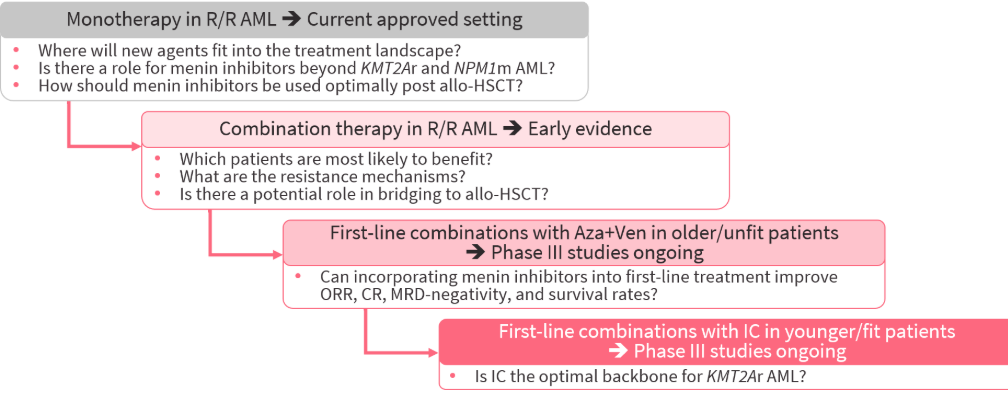
During his presentation, Zeidner provides an overview of the mechanism of action of menin inhibitors and discusses the rationale for their use in patients with AML. He explores the clinical evidence for the use of menin inhibitors in patients with relapsed/refractory (R/R) and newly diagnosed (ND) AML, both as a monotherapy and in combination with other agents, and across different patient populations. He concludes by highlighting the evolving role of menin inhibitors across treatment settings (Figure 1). The subsequent discussion focuses on patient eligibility for menin inhibitor combinations and regional differences in treatment strategies.
Figure 1. Menin inhibitors in the evolving AML landscape
Targeting menin: A paradigm shift in acute myeloid leukemia therapy
Targeting menin: A paradigm shift in acute myeloid leukemia therapy
Key points
- Menin inhibitors are an important new therapeutic class for patients with AML, particularly for patients with KMT2A-rearranged (KMT2Ar) or NPM1-mutated (NPM1m) disease.1
- Revumenib and ziftomenib have demonstrated clinically meaningful activity as a monotherapy in R/R AML, leading to U.S. Food and Drug Administration (FDA) approvals for molecularly defined patient populations; however, response rates remain <50% in patients with NPM1m R/R AML, with a median duration of response of <5 months.2–8
- Next-generation menin inhibitors, such as bleximenib and enzomenib, have shown promising initial efficacy as a monotherapy in R/R AML.10,11
- Early results from studies evaluating menin inhibitor combination therapies suggest the potential to improve activity beyond monotherapy in R/R AML.
- Results from the phase I/II SAVE trial (NCT05360160) showed high response rates with revumenib + decitabine/cedazuridine (ASTX727) + venetoclax in patients with KMT2Ar (overall response rate [ORR], 100%) or NPM1m (ORR, 75%) R/R AML.12
- Results from the phase Ia/b KOMET-007 trial (NCT05735184) of ziftomenib + azacitidine + venetoclax demonstrated an ORR and complete response of 67% and 42%, respectively, in patients with NPM1m R/R AML.13
- In older/unfit patients with ND AML, triplet combinations incorporating menin inhibitors have been associated with high response rates.
- Results from the BEAT AML trial (NCT03013998) showed encouraging efficacy with revumenib + azacitidine + venetoclax in patients aged ≥60 years with KMT2Ar or NPM1m AML, with ORRs of 100% and 85%, respectively.14
- Results from the KOMET-007 trial demonstrated promising efficacy with ziftomenib + azacitidine + venetoclax in unfit patients aged >18 years with ND NPM1m AML, with an ORR of 89%.15
- Menin inhibitors are also being evaluated in combination with intensive chemotherapy (7+3) in younger/fit patients with ND AML, with updated results presented during the European Hematology Association (EHA) 2026 Congress, June 11–14, 2026, Stockholm, SE.
- Results from the KOMET-007 trial showed high ORRs (95%; NPM1m, 98%; KMT2Ar, 92%) with ziftomenib + 7+3 in fit patients with ND AML.16
- In the phase I SNDX-5613-0708 trial, revumenib + 7+3 was associated with an ORR of 100% at dose level 1 (110 mg/220 mg ± strong CYP3A4 inhibitor [CYP3A4i]) and 93% at dose level 2 (160 mg/270 mg ± strong CYP3A4i) in patients with ND NPM1m, KMT2Ar, or NUP98r AML.17
- These results have led to the development of multiple randomized, phase III, placebo-controlled trials for both older/unfit patients, such as EVOLVE-2 (revumenib + azacitidine + venetoclax; NCT06652438), cAMeLot-2 (bleximenib + azacitidine + venetoclax; NCT06852222), and KOMET-017 (ziftomenib + azacitidine + venetoclax; NCT07007312) and in younger/fit patients, including KOMET-017-IC (ziftomenib + 7+3; NCT07007312), HOVON 181 AML/AML-SG 37-25 (bleximenib + 7+3; NCT07223814), and REVEAL-ND (revumenib + 7+3; NCT07211958).18–22
- As menin inhibitors are being evaluated in earlier lines of therapy, their potential integration with transplant strategies in fit patients with AML remains an important consideration.
- Further evaluation is also needed to determine the optimal treatment duration and consolidation and maintenance strategies in patients with NPM1m AML.
- The potential role of menin inhibitor-based combination therapies in both younger/fit and older/unfit patients with ND AML remains under investigation, with several phase III trials underway; identifying the patient populations most likely to benefit from this approach is a key objective.
This educational activity is independently supported by Kura Oncology. All content is developed by SES in collaboration with an expert steering committee. Funders are allowed no influence.
References
Please indicate your level of agreement with the following statements:
The content was clear and easy to understand
The content addressed the learning objectives
The content was relevant to my practice
I will change my clinical practice as a result of this content
This content is accurate as of the date of publication and is not updated retrospectively. Please refer to the latest available evidence, guidelines, and relevant regulatory information when making clinical decisions.
.webp)
.webp)