All content on this site is intended for healthcare professionals only. By acknowledging this message and accessing the information on this website you are confirming that you are a healthcare professional. If you are a patient or carer, please visit Know AML.
The AML Hub website uses a third-party service provided by Google that dynamically translates web content. Translations are machine generated, so may not be an exact or complete translation, and the AML Hub cannot guarantee the accuracy of translated content. The AML Hub and its employees will not be liable for any direct, indirect, or consequential damages (even if foreseeable) resulting from use of the Google Translate feature. For further support with Google Translate, visit Google Translate Help.


The AML Hub is an independent medical education platform, sponsored by Daiichi Sankyo, Kura Oncology, Syndax, Abbvie, Thermo Fisher and Johnson & Johnson. Funders are allowed no direct influence on our content. The levels of sponsorship listed are reflective of the amount of funding given. View funders.
Now you can support HCPs in making informed decisions for their patients
Your contribution helps us continuously deliver expertly curated content to HCPs worldwide. You will also have the opportunity to make a content suggestion for consideration and receive updates on the impact contributions are making to our content.
Find out more
Create an account to access:
Bookmark & personalize site content
Receive alerts for new content in your areas of interest
View AML content recommended for you
Efficacy and safety of menin inhibitors in the treatment of AML: Congress insights
Do you know... Which statement best describes the current clinical development of menin inhibitors in AML?
Menin inhibitors have emerged as a promising targeted therapeutic approach for patients with NPM1-mutated (NPM1m) or KMT2A-rearranged (KMT2Ar) acute myeloid leukemia (AML), with both revumenib now approved by the U.S. Food and Drug Administration (FDA) as monotherapy for the treatment of adult and pediatric patients with relapsed/refractory (R/R) NPM1m AML or KMT2Ar acute leukemia and ziftomenib monotherapy also approved for the treatment of adults with R/R NPM1m AML.1,2 Other menin inhibitors are in clinical development, including bleximenib, enzomenib, and balomenib.3–11 Key efficacy and safety updates from several ongoing clinical trials were reported at recent congresses and are summarized below (Table 1).
Table 1. Overview of ongoing trials of menin inhibitors
| Menin inhibitor | Trial | Intervention | Population | Primary endpoint(s) |
| Bleximenib | Phase Ib ALE1002 (NCT05453903)3–5 | Bleximenib + Ven±Aza or 7+3 | ND or R/R NPM1m, KMT2Ar, or NUP98/214r AML | Safety, DLTs |
| Phase I/II cAMeLot-1 (NCT04811560)5,6 | Bleximenib monotherapy | R/R KMT2Ar, NPM1m, NUP98/214r acute leukemia | Safety, DLTs, and CR/CRh rate | |
| Phase III HOVON 181 AML (NCT07223814)7,8 | Bleximenib or placebo, + standard induction and consolidation, followed by bleximenib or placebo maintenance | ND NPM1m or KMT2Ar AML, eligible for IC | EFS | |
| Enzomenib | Phase I/II Horizen-1 (NCT04988555)9–11 | Enzomenib ± Ven+Aza or 7+3 | R/R KMT2Ar or NPM1m acute leukemia | Safety, RP2D, and CR/CRh rate |
| Revumenib | Phase I/II SAVE (NCT05360160)12–15 | Revumenib + decitabine/cedazuridine + Ven | ND or R/R NPM1m, KMT2Ar or NUP98r AML or MPAL | Safety and RP2D |
| Phase I/II AUGMENT-101 (NCT04065399)15–21 | Revumenib | NPM1m, KMT2Ar or NUP98r AML or acute leukemia | CR/CRh rate, DLTs, safety, and tolerability | |
| Phase III EVOLVE-2 (NCT06652438)22,23 | Revumenib or placebo, + Ven+Aza | ND NPM1m or KMT2Ar AML, ineligible for IC | OS and CR rate | |
| Phase III REVEAL-ND NPM1 (NCT07211958)24,25 | Revumenib or placebo, + IC | ND NPM1m AML | EFS and MRD-negative CR rate | |
| Phase I SNDX-5613-0708 (NCT06226571)26,27 | Revumenib + cytarabine + daunorubicin or idarubicin | ND NPM1m, KMT2Ar, or NUP98r AML, eligible for IC | DLTs and safety | |
| Ziftomenib | Phase I KOMET-007 (NCT05735184)28–31 | Ziftomenib + Ven±Aza, 7+3, or 7+3 + quizartinib | ND or R/R KMT2Ar or NPM1m AML | CR rate, DLTs, and AEs |
7+3, cytarabine + daunorubicin or idarubicin; AE, adverse event; AML, acute myeloid leukemia; Aza, azacitidine; CR, complete remission; CRc, composite CR; CRh, CR with partial hematologic recovery; EFS, event-free survival; IC, intensive chemotherapy; KMT2Ar, KMT2A-rearranged; MPAL, mixed-lineage acute leukemia; MRD, measurable residual disease; ND, newly diagnosed; NPM1m, NPM1-mutated; NUP98/214r, NUP98/214-rearranged; RP2D, recommended phase II dose; R/R, relapsed/refractory; Ven, venetoclax.
Bleximenib
ALE1002 (NCT05453903)3,4
Updated safety and efficacy data from the ongoing ALE1002 trial (NCT05453903; Table 1) were reported at the 67th American Society of Hematology (ASH) Annual Meeting and Exposition; Dec 6–9, 2025; Orlando, US, for patients with newly diagnosed (ND) NPM1m or KMT2Ar AML treated with bleximenib + cytarabine + daunorubicin or idarubicin (7+3), with a median follow-up of 9.1 months.3,4
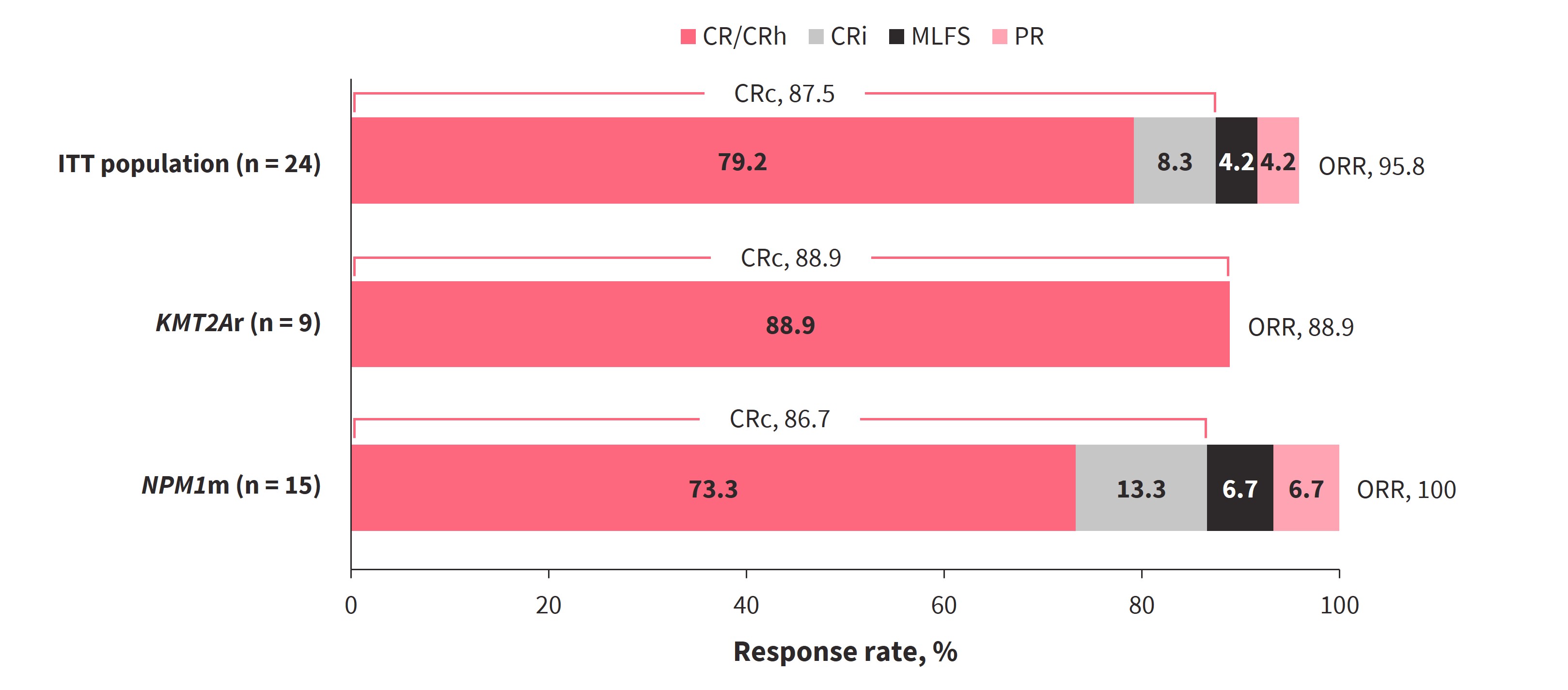
- Bleximenib 100 mg BID + 7+3 demonstrated a manageable safety profile and encouraging early efficacy results (Figure 1) in patients with KMT2Ar or NPM1m AML, with comparable response rates between mutational subgroups.3
- Grade ≥3 treatment-emergent adverse events (TEAEs) occurred in 100% of patients treated with the bleximenib recommended phase II dose (RP2D) of 100 mg BID (n = 25).3
- The most common Grade ≥3 hematologic treatment-emergent adverse events (TEAEs) were thrombocytopenia (88.0%), neutropenia (76.0%), anemia (72.0%), febrile neutropenia (68.0%), and leukopenia (44.0%).3
- The most common Grade ≥3 non-hematologic TEAEs were stomatitis (20.0%), diarrhea (8.0%), increased alanine aminotransferase (ALT; 8.0%), increased aspartate aminotransferase (AST; 8.0%), and hypotension (8.0%).3
- Across all dose levels (N = 44), no differentiation syndrome (DS) events occurred. Grade 1/2 corrected QT interval (QTc) prolongation occurred in three patients, and all resolved without interruption of bleximenib.3
- Among responding patients with evaluable measurable residual disease data (n = 15), 80% demonstrated measurable residual disease (MRD) negativity.3
Figure 1. ALE1002: Efficacy outcomes for bleximenib + 7+3 in patients with ND AML3
cAMeLot-1 (NCT04811560) and ALE1002 (NCT05453903): Cardiac safety5,6
Cardiac safety data from both the cAMeLot-1 trial (NCT04811560) bleximenib monotherapy population (N = 141), and the overall ALE1002 population (N = 193; Table 1), were presented during the European Hematology Association (EHA) 2026 Congress, June 11–14, 2026, Stockholm, SE.5
- In cAMeLot-1, there were no instances of Grade 1/2 treatment-emergent QTc prolongation, while Grade 3 treatment-emergent QTc prolongation occurred in 0.7% of patients.5
- The Grade 3 QTc prolongation occurred in a patient with ongoing cardiovascular comorbidities at baseline, at a non-RP2D (100 mg once daily, without step-up dosing).
- In ALE1002, Grade 1/2 and 3 treatment-emergent QTc prolongation occurred in 4.1% and 0.5% of patients, respectively.5
- One Grade 3 QTc prolongation was observed in a patient treated with bleximenib + Ven+Aza and concomitant QTc-prolonging therapies. Two further Grade 3 QTc events were identified by central ECG review, in conjunction with electrolyte imbalances.
- There were no dose-dependent effects of bleximenib on QTc prolongation in either cAMeLot-1 or ALE1002.5
- No clinically meaningful QTc prolongation was observed with bleximenib treatment, and no cardiac safety signal was identified across the two studies.5
HOVON 181 AML (NCT07223814)7,8
The trial design of the prospective, randomized, phase III HOVON 181 AML (AMLSG 37-25) trial (NCT07223814; Table 1), was presented at ASH 2025. The trial will investigate the efficacy and safety of bleximenib vs placebo in combination with standard-of-care induction and consolidation, followed by maintenance therapy, in patients with ND KMT2Ar or NPM1m AML.7,8
- Approximately 875 patients aged ≥18 years with ND KMT2Ar or NPM1m AML, eligible for intensive chemotherapy (IC), have an Eastern Cooperative Oncology Group performance status (ECOG PS) ≤2, and adequate hepatic and renal function will be randomized into three arms.7,8
- Those in Arms 1 and 2 will receive 2 cycles of bleximenib + 7+3 induction therapy, followed by consolidation with bleximenib + intermediate-dose cytarabine (IDAC) or allogeneic hematopoietic stem cell transplantation (allo-HSCT).
- Arm 1 are then given bleximenib monotherapy maintenance, while Arm 2 are given placebo.
- Those in Arm 3 will receive 2 cycles of placebo + 7+3 induction therapy, followed by placebo + IDAC/allo-HSCT consolidation therapy, and placebo maintenance.
- The primary endpoint is event-free survival (EFS); secondary endpoints include overall survival (OS), duration of complete response (CR), CR rate, and adverse event (AE) incidence.7,8
Enzomenib
Horizen-19–11
Data from the enzomenib monotherapy and enzomenib + Ven+Aza arms of the ongoing Horizen-1 (NCT04988555) dose escalation and expansion trial (Table 1), were presented at ASH 2025.9–11
- Enzomenib 300 mg BID monotherapy was selected as the RP2D in patients with R/R KMT2Ar acute leukemia (n = 39).10
- In patients treated at the RP2D (n = 15), the ORR, CRc, and CR/CRh rates were 73.3%, 60%, and 40%, respectively.
- Enzomenib monotherapy dose optimization is ongoing in patients with R/R NPM1m; initial responses were similar across enzomenib 200 mg, 300 mg, and 400 mg BID doses (n = 25).10
- The ORR with 200 mg, 300 mg, and 400 mg was 60%, 57.1%, and 37.5%, respectively.
- The most common Grade ≥3 TEAEs with enzomenib monotherapy (N = 116) were febrile neutropenia (26.7%), decreased platelet count (21.6%), and decreased neutrophil count (20.7%).10
- Grade ≥3 treatment-related DS occurred in 7.8% of patients; no deaths or permanent enzomenib discontinuations due to DS were reported.
- Grade 3 QTc prolongation events were observed in 2.6% of patients; none were considered treatment-related, and no permanent enzomenib discontinuations due to QTc prolongation occurred.
- No dose-limiting toxicities were observed at any enzomenib dose.
- Preliminary efficacy data from the analysis of enzomenib + Ven+Aza in patients with R/R AML (n = 26) demonstrate encouraging response rates, with an ORR of 77% and a CRc rate of 50%.11
- In the safety population (n = 40), the most common Grade ≥3 TEAEs were decreased platelet count (45.0%), and decreased white blood cell count (35.0%), decreased neutrophil count (35.0%), anemia (20.0%), and febrile neutropenia (22.5%).
- Any-grade DS occurred in 10% of patients, and there were no Grade ≥3 DS events.
- QTc prolongation of any Grade occurred in 10% of patients, and there were no Grade ≥3 QTc prolongations.
Revumenib
SAVE (NCT05360160)12–14
Findings from the SAVE trial (NCT05360160; Table 1) in patients with ND AML were presented at ASH 2025, and in patients with R/R AML/myeloid mixed phenotype acute leukemia (MPAL) at EHA2026, confirming the efficacy and safety of all-oral revumenib + decitabine/cedazuridine (ASTX727) + Ven in these indications.12–14
- In the ND population, the ORR in all patients (n = 21), in the NPM1m subgroup (n = 14), and in the KMT2Ar subgroup (n = 7), was 86% each.12
- The CR/CR with partial hematologic recovery (CRh) rate in all patients was 81% (KMT2Ar, 86%; NPM1m, 79%).
- The most common Grade ≥3 TEAEs were febrile neutropenia (48%), thrombocytopenia (33%), and neutropenia (24%).
- Treatment-emergent Grade ≥3 DS occurred in 10% of patients, and any-grade treatment-emergent QTc prolongation occurred in 43% of patients, with no Grade ≥3 events.
- In patients with R/R AML/MPAL, the ORR was 88% overall, and 100%, 75%, and 89% in the KMT2Ar (n = 17), NPM1m (n = 16), and NUP98r (n = 9) subgroups, respectively.13
- The CR/CRh rate was 60% (KMT2Ar, 53%; NPM1m, 65%; NUP98r, 60%).
- The most common Grade ≥3 TEAEs were febrile neutropenia (36%), lung infections (21%), decreased platelet count (21%), and increased AST/ALT (21%).
- Treatment-emergent Grade ≥3 DS and QTc prolongation were each reported in 5% of patients.
AUGMENT-101 (NCT04065399)15–21,32
Post hoc analyses and long-term follow-up data from the phase I/II AUGMENT-101 trial (NCT04065399; Table 1), investigating the safety and efficacy of revumenib in adult and pediatric patients with R/R KMT2Ar, NPM1m, or NUP98r acute leukemia or AML, were presented at ASH 2025, EHA2026, and the 2026 American Society of Clinical Oncology (ASCO) Annual Meeting, May 29 – June 2, 2026, Chicago, US.15–21,32
- Clinically meaningful responses and a manageable safety profile were demonstrated with revumenib monotherapy in patients with KMT2Ar acute leukemia, irrespective of leukemia subtype.17
- The CR/CRh rate in the efficacy population was similar in patients with AML (n = 78; 23.1%), acute lymphoblastic leukemia (ALL; n = 13; 23.1%), and MPAL (n = 6; 16.7%).
- In the safety population, Grade ≥3 TRAEs occurred in 57.9%, 26.7%, and 66.7% of patients with AML (n = 95), ALL (n = 15), or MPAL (n = 6); Grade ≥3 DS was reported in 14.7%, 13.3%, and 16.7%, respectively. Grade ≥3 QTc prolongation occurred in 15.8% of patients with AML and in no patients with ALL or MPAL.
- In patients with NPM1m acute leukemias with co-mutations (N = 54), the ORR was found to be highest in those with FLT3 + IDH1/2 (n = 8; 75%), IDH1/2 (n = 14; 71.4%), or DNMT3A + IDH1/2 (n = 9; 66.7%) co-mutations.18
- Rates of Grade ≥3 DS (15%) and QTc prolongation (20%) were consistent with the overall AUGMENT-101 population.
- Pooled phase I and II data showed encouraging efficacy and safety of revumenib as post-allo-HSCT maintenance in R/R KMT2Ar (n = 14), NPM1m (n = 4), and NUP98r (n = 1) AML.19
- Overall, median relapse-free survival (RFS) and median OS were not reached (NR); 12-month RFS was 78.6%.
- Grade ≥3 TEAEs were reported in 74% of patients, most commonly thrombocytopenia/decreased platelet count (42%) and decreased neutrophil count (16%). One Grade ≥2 QTc prolongation occurred (5%), unrelated to revumenib, and no DS events were reported.
- Long-term follow-up data for pediatric and young adult patients (n = 36) demonstrated clinically meaningful responses with revumenib monotherapy across acute leukemia subtypes, with a median CR/CRh duration of 32.3 months.20
- Grade ≥3 TEAEs occurred in 92% of patients in the safety population (n = 38). Any-grade DS and QTcF prolongation occurred in 34% and 21% of patients, respectively.
- Potential clinical benefit and tolerability of revumenib in patients with R/R NUP98r acute leukemia was demonstrated, supported by data from an expanded access program (EAP; NCT05918913).21,32
- The CRc rate in the efficacy population (n = 25) was 28%, and 42.9% of responding patients proceeded to transplant.21
- Grade ≥3 TEAEs occurred in 69% of patients in the safety population (n = 26); Grade ≥3 DS and QTcF prolongation were observed in 4% and 8% of patients, respectively.21
- Findings from a post hoc analysis of pooled data from the AUGMENT-101, EAP, and SAVE trials demonstrated the feasibility of revumenib as post-allo-HSCT maintenance in patients with ND or R/R KMT2Ar, NPM1m, or NUP98r AML (n = 24).15
- Survival outcomes were encouraging in relation to historical data; OS was 90% at both 1 and 2 years post-HSCT, and 1- and 2-year EFS was 82% and 72%, respectively.
- The most common Grade ≥3 TEAEs were thrombocytopenia (46%), infection (8%), neutropenia (4%), graft-versus-host-disease (4%), and diarrhea (4%).
- Neither DS nor QTc prolongation of any grade were observed post-transplant.
EVOLVE-2 (NCT06652438)22,23 and REVEAL-ND NPM1 (NCT07211958): Trial designs24,25
The trial designs of two randomized, double-blind, phase III trials of revumenib were presented at the 2026 ASCO Annual Meeting: EVOLVE-2 (NCT06652438); and REVEAL-ND NPM1 (NCT07211958; Table 1). EVOLVE-2 will investigate the efficacy of revumenib vs placebo in combination with Ven+Aza in patients with ND KMT2Ar or NPM1m AML who are ineligible for IC,22,23 and REVEAL-ND NPM1 will evaluate the safety and efficacy of revumenib vs placebo in combination with IC in ND NPM1m AML.24,25
SNDX-5613-0708 (NCT06226571)26,27
Updated findings from the ongoing phase I SNDX-5613-0708 trial (NCT06226571; Table 1), investigating the safety and efficacy of revumenib in combination with IC for the treatment of ND KMT2Ar, NPM1m, or NUP98r AML (N = 35), were presented at EHA2026.26,27
- Encouraging response rates were demonstrated in the efficacy population, with ORR and CRc rates both of 97.1%; MRD negativity was achieved in 86.2% of patients with CRc.27
- Grade ≥3 TEAEs occurred in 91% of patients; the most common were thrombocytopenia (57%), febrile neutropenia (54%), and neutropenia (46%).27
- Grade ≥3 treatment-emergent DS occurred in 3% of patients.
- Grade ≥3 treatment-emergent QTcF prolongation was observed in 17% of patients.
Ziftomenib
KOMET-007 (NCT05735184)28–31
Findings from the ziftomenib + Ven+Aza arm of the ongoing phase I KOMET-007 trial (NCT05735184; Table 1), in patients with R/R KMT2Ar or NPM1m AML treated with ziftomenib + Ven+Aza (N = 83), were presented at ASH 2025.28–31
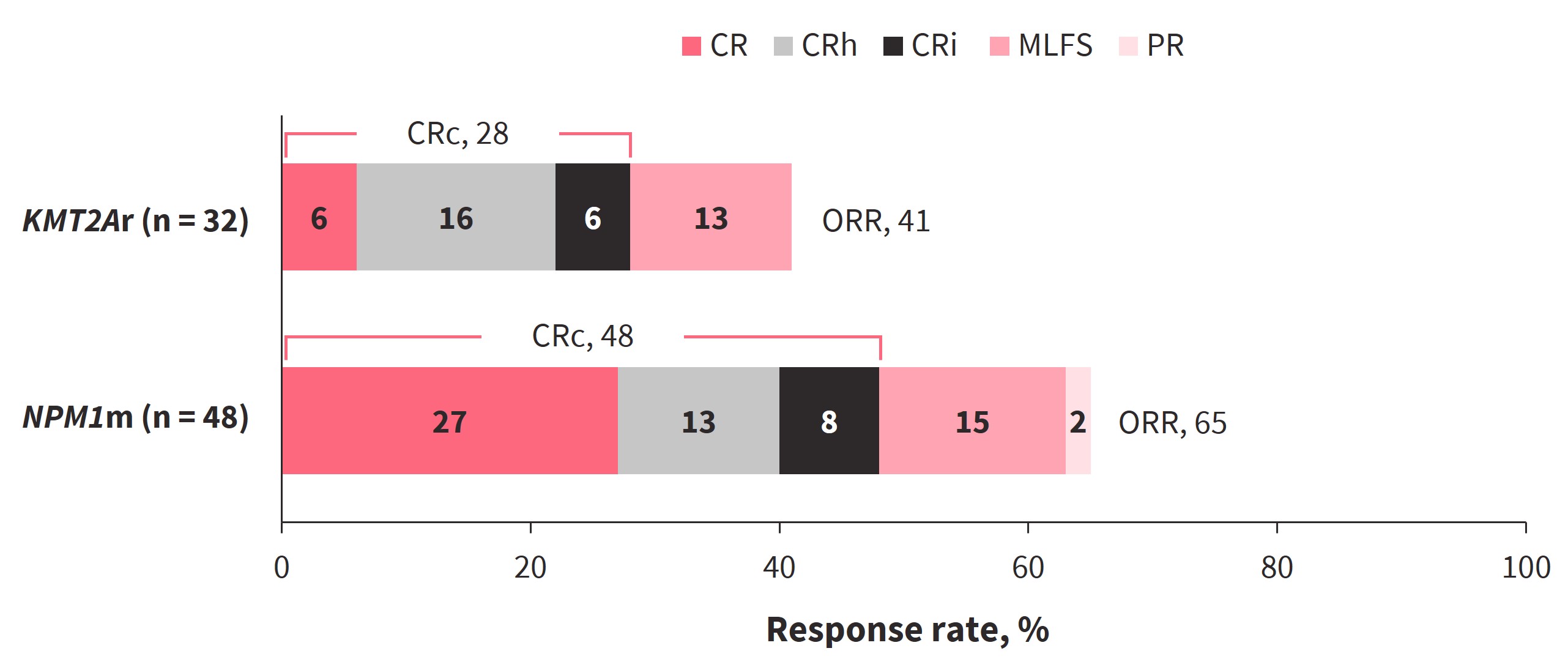
- Encouraging response rates were demonstrated in the efficacy analysis of patients with R/R AML (Figure 2).29
- Among patients achieving CRc, MRD negativity rates were 43% in the KMT2Ar arm, and 60% in the NPM1m arm.
- Grade ≥3 TEAEs occurred in 92% of patients; the most common were thrombocytopenia (34%), febrile neutropenia (31%), leukopenia (31%), and neutropenia (31%).
- One (1%) Grade ≥3 DS event was reported, which was resolved with protocol-specified mitigation.
- There was no QTc prolongation observed.
- In the efficacy population of patients with ND NPM1m AML (n = 37), the ORR was 89%, and the CRc was 86%.30
- Among patients with CRc response, 44% achieved MRD negativity at a threshold of ≤0.01% sensitivity.
- In the safety population (N = 40), Grade ≥3 TEAEs occurred in 85% of patients.28 The most common were neutropenia (38%), thrombocytopenia (28%), leukopenia (25%), and anemia (20%).
- DS occurred in 1 patient (3%; Grade 2) and was resolved with protocol-specified mitigation.
- QTc prolongation occurred in one patient (3%, Grade 3) with concomitant electrolyte imbalances and was resolved with electrolyte repletion.
Long-term data for ziftomenib + 7+3 in patients with ND KMT2Ar (n = 50) or NPM1m (n = 49) AML were shared at EHA2026.31
- The ORR was 95% (92% the KMT2Ar arm; 98% in the NPM1m arm).31
- The CRc rate was 93% in all patients, 90% in those with KMT2Ar AML, and 96% in those with NPM1m AML.
- MRD negativity in patients with CRc was 84% (82% in the KMT2Ar arm; 85% in the NPM1m arm).
- Grade ≥3 TEAEs occurred in 96% of patients.31
- The most common were febrile neutropenia (63%), thrombocytopenia (60%), anemia (37%), neutropenia (31%), and leukopenia (28%).
- Grade 3 DS events were reported in 4% of patients; all were successfully resolved with protocol-specified mitigation.
- Grade 3 QTc prolongation occurred in 3% of patients, and all were managed successfully.
Figure 2. KOMET-007: Efficacy outcomes for ziftomenib + Ven+Aza in patients with R/R AML29
Conclusions
Data presented at recent congresses highlight the continued evolution of the menin inhibitor landscape in AML, with clinical development increasingly moving beyond monotherapy in R/R disease and towards combination approaches and earlier treatment settings. Encouraging early efficacy data have been reported with menin inhibitors combined with IC and Ven-based regimens, while ongoing phase III trials will provide further evidence to help define the role of these agents in frontline treatment.
This educational resource is independently supported by Johnson & Johnson. All content is developed by SES in collaboration with an expert steering committee. Funders are allowed no influence.
References
Please indicate your level of agreement with the following statements:
The content was clear and easy to understand
The content addressed the learning objectives
The content was relevant to my practice
I will change my clinical practice as a result of this content
.webp)