All content on this site is intended for healthcare professionals only. By acknowledging this message and accessing the information on this website you are confirming that you are a healthcare professional. If you are a patient or carer, please visit Know AML.
The AML Hub website uses a third-party service provided by Google that dynamically translates web content. Translations are machine generated, so may not be an exact or complete translation, and the AML Hub cannot guarantee the accuracy of translated content. The AML Hub and its employees will not be liable for any direct, indirect, or consequential damages (even if foreseeable) resulting from use of the Google Translate feature. For further support with Google Translate, visit Google Translate Help.


The AML Hub is an independent medical education platform, sponsored by Daiichi Sankyo, Kura Oncology, Syndax, Abbvie, Thermo Fisher and Johnson & Johnson. Funders are allowed no direct influence on our content. The levels of sponsorship listed are reflective of the amount of funding given. View funders.
Now you can support HCPs in making informed decisions for their patients
Your contribution helps us continuously deliver expertly curated content to HCPs worldwide. You will also have the opportunity to make a content suggestion for consideration and receive updates on the impact contributions are making to our content.
Find out more
Create an account to access:
Bookmark & personalize site content
Receive alerts for new content in your areas of interest
View AML content recommended for you
What have we learned from emerging next-generation menin inhibitor data, and how are they evolving?
Featured:
Do you know... Which statement best describes the emerging clinical evidence supporting next-generation menin inhibitors for the treatment of AML?
The AML Hub was pleased to speak with Emma Searle, The Christie NHS Foundation Trust, Manchester, UK. We asked, What have we learned from emerging next-generation menin inhibitor data, and how are they evolving?
What have we learned from emerging next-generation menin inhibitor data, and how are they evolving?
During this interview, Searle discusses emerging data for next-generation menin inhibitors, including bleximenib and enzomenib, as monotherapies and in combination regimens for the treatment of acute myeloid leukemia (AML). She explores their efficacy and tolerability profiles, mechanisms of resistance to menin inhibition, and the potential role of these agents in first-line treatment, alongside the challenge of managing subsequent relapse.
Key points
- Two first-generation menin inhibitors have received approval from the U.S. Food and Drug Administration (FDA): revumenib for the treatment of relapsed/refractory (R/R) KMT2A-rearranged (KMT2Ar) acute leukemia or NPM1-mutated (NPM1m) AML, and ziftomenib for the treatment of R/R NPM1m AML.1,2
- Next-generation menin inhibitors, including bleximenib and enzomenib, are now being investigated to build on these and improve treatment outcomes for patients with KMT2Ar or NPM1m AML.
- Bleximenib was granted orphan drug designation for the treatment of AML by the FDA in October 2024, while enzomenib received FDA breakthrough therapy designation for the treatment of R/R KMT2Ar acute leukemia in October 2026, reflecting their potential in these settings.3,4
- Emerging clinical trial data have demonstrated encouraging activity for next-generation menin inhibitor monotherapy approaches in patients with R/R KMT2Ar or NPM1m acute leukemia.
- In the phase I/II cAMeLot-1 trial (NCT04811560) efficacy population, complete remission (CR) or CR with partial hematologic recovery (CRh) was achieved in 33% of patients treated with bleximenib 90/100 mg twice daily (BID; n = 21) and 40% of those treated with 150 mg BID (n = 20). Bleximenib 100 mg BID was selected as the recommended phase II dose (RP2D).5
- In the phase I/II Horizen-1 trial (NCT04988555), enzomenib 300 mg BID monotherapy was selected as the RP2D for the KMT2Ar acute leukemia arm (n = 15), with a CR/CRh rate of 40% and a composite CR (CRc) rate of 60%.6 In the NPM1m AML arm (n = 25), CR/CRh rates of ~44% were reported across the dose levels evaluated; dose optimization is ongoing.6
- Positive early-phase clinical findings have been observed with next-generation menin inhibitors in combination with venetoclax (Ven) and azacitidine (Aza) in patients with R/R KMT2Ar or NPM1m AML. Responses were observed in patients with and without prior Ven exposure, although rates were generally higher in patients without prior Ven exposure.
- In the phase Ib ALE1002 trial (NCT05453903), an ORR of 79% and a CR/CRh/CR with incomplete hematologic recovery (CRi) rate of 41% were noted in patients treated with bleximenib 50–100 mg BID + Ven + Aza (efficacy population, n = 34).7
- In patients without prior Ven exposure (n = 17), the ORR and CR/CRh/CRi rate were 94% and 53%, respectively, compared with 65% and 29% in patients previously treated with Ven (n = 17).7
- Updated results demonstrated an ORR of 82% and a CR/CRh/CRi rate of 59% in patients treated with bleximenib 100 mg BID + Ven + Aza (efficacy population, n = 22).8
- Response rates were again higher in patients without prior Ven exposure (n = 15; ORR, 93%; CR/CRh/CRi, 73%) than in those previously treated with Ven (n = 7; ORR, 57%; CR/CRh/CRi, 29%).8
- In patients treated with the doublet of bleximenib + Ven without a hypomethylating agent (n = 13), the ORR was 69% and the CRc rate was 39%.9
- The ORR and CRc rate were 71% and 57% in patients without prior Ven exposure (n = 7), and 67% and 17% in those previously treated with Ven (n = 6).9
- In the Horizen-1 trial, enzomenib + Ven + Aza demonstrated an ORR of 77% and a CRc rate of 50% in patients with R/R AML (n = 26). These increased to 85% and 62%, respectively, in patients without prior Ven or menin inhibitor exposure (n = 13).10
- In the phase Ib ALE1002 trial (NCT05453903), an ORR of 79% and a CR/CRh/CR with incomplete hematologic recovery (CRi) rate of 41% were noted in patients treated with bleximenib 50–100 mg BID + Ven + Aza (efficacy population, n = 34).7
- Emerging safety data for next-generation menin inhibitors have highlighted potential benefits for their use in combination regimens.
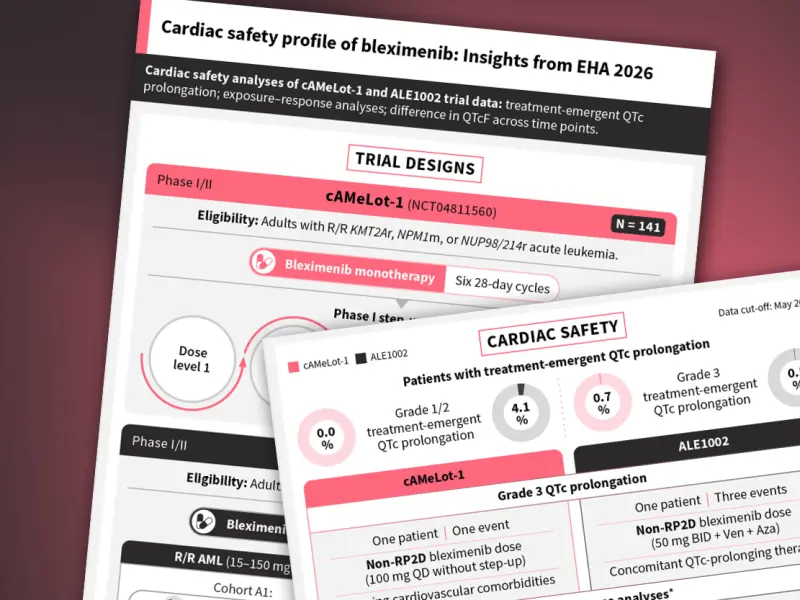
- A clinically meaningful corrected QT (QTc) interval prolongation signal has not been seen with either bleximenib or enzomenib, which may be beneficial when combining these therapies with other treatments.11
- Differentiation syndrome (DS) remains an important class-related adverse event. The short half-life (2–4 hours) and reduced tissue accumulation of enzomenib may facilitate rapid drug clearance following its interruption and could therefore potentially be beneficial in managing DS.6
- Acquired resistance remains a challenge associated with menin inhibitor therapy; in a subset of patients in the phase I dose-escalation stage of the AUGMENT-101 trial (NCT04065399), acquired MEN1 mutations were identified in approximately 39% of responding and non-responding patients treated with revumenib for ≥2 cycles (n = 31), providing evidence of an on-target mechanism of resistance.12
- Resistance can, however, develop in the absence of acquired MEN1 mutations, indicating that additional mechanisms contribute to resistance to menin inhibition.12
- Differences in the resistance mutations emerging with individual menin inhibitors may create opportunities for sequential treatment, whereby switching to an alternative menin inhibitor following resistance may potentially restore sensitivity in selected patients. However, the efficacy and durability of responses with this approach remain to be established.13
- As menin inhibitor-based combinations move into earlier treatment settings, relapse following exposure to multiple targeted therapies is likely to become an increasingly important clinical challenge.14
- This may be particularly relevant for older patients who are not eligible for intensive therapy or allogeneic hematopoietic stem cell transplantation (allo-HSCT), who may subsequently relapse following treatment with a menin inhibitor + Ven + Aza.14
- Important areas for future research include the development of menin inhibitors in combination strategies beyond Ven + Aza, and further novel approaches to menin inhibition that may overcome existing resistance mechanisms, with the aim of improving both initial treatment responses and outcomes following relapse.
This educational resource is independently supported by Johnson & Johnson. All content is developed by SES in collaboration with an expert steering committee. Funders are allowed no influence.
References
- Revumenib. Prescribing Information (FDA). 2024. Revised Oct 2025.
- Ziftomenib. Prescribing Information (FDA). 2025. Revised Nov 2025.
- U.S. Food and Drug Administration. Search Orphan Drug Designations and Approvals. https://www.accessdata.fda.gov/scripts/opdlisting/oopd/detailedIndex.cfm?cfgridkey=1035624. Updated Oct 19, 2024. Accessed Nov 2, 2026.
- Business Wire. Sumitomo Pharma America announces enzomenib (DSP-5336) receives FDA breakthrough therapy designation for treatment of R/R KMT2A-rearranged acute leukemia. https://www.businesswire.com/news/home/20261026951054/en/Sumitomo-Pharma-America-Announces-Enzomenib-DSP-5336-Receives-FDA-Breakthrough-Therapy-Designation-for-Treatment-of-RR-KMT2A-Rearranged-Acute-Leukemia. Published Oct 26, 2026. Accessed Oct 30, 2026.
- Searle E. Bleximenib dose optimization and determination of recommended phase 2 dose from a phase 1 study in relapsed/refractory acute leukemia with KMT2A or NPM1 alterations. Oral Abstract #212. Presented at: 66th American Society of Hematology Annual Meeting and Exposition; Dec 7–10, 2024; San Diego, US.
- Daver N. Monotherapy update from phase 1 portion in phase 1/2 trial of the menin-MLL inhibitor enzomenib (DSP-5336) in patients with relapsed or refractory acute leukemia. Oral Abstract #763. Presented at: 67th American Society of Hematology Annual Meeting and Exposition; Dec 6–9, 2025; Orlando, US.
- Wei AH. A phase 1b study of the menin-KMT2A inhibitor bleximenib (JNJ-75276617) in combination with venetoclax and azacitidine in relapsed/refractory acute myeloid leukemia with alterations in KMT2A or NPM1. Oral Abstract #S133. Presented at: European Hematology Association 2024 Hybrid Congress; Jun 13–16, 2024; Madrid, ES.
- Wei AH. RP2D determination of bleximenib in combination with Ven + Aza: phase 1b study in R/R & ND AML with KMT2A/NPM1 alterations. Oral Abstract #S137. Presented at: European Hematology Association 2025 Congress; Jun 12–15, 2025; Milan, IT.
- O'Nions J, Wei AH, Esteve J, et al. Phase 1b study of bleximenib in combination with venetoclax in acute myeloid leukemia with KMT2A or NPM1 alterations. Blood. 2025;146(Suppl.1):5200. DOI: 10.1182/blood-2025-5200
- Watts J. Preliminary data from the ongoing phase 1 study of enzomenib (DSP-5336) in combination with venetoclax and azacitidine in patients with relapsed or refractory acute myeloid leukemia. Oral Abstract #765. Presented at: 67th American Society of Hematology Annual Meeting and Exposition; Dec 6–9, 2025; Orlando, US.
- Abdul-Hay M, Abedin S, Aldoss I, et al. No evidence of QTc interval prolongation with the menin inhibitor bleximenib when given as monotherapy or in combination with AML-directed therapies for KMT2A or NPM1 altered AML. Poster #PF555. Presented at: European Hematology Association 2026 Congress; Jun 11–14, 2026; Stockholm, SE.
- Perner F, Stein EM, Wenge, DV, et al. MEN1 mutations mediate clinical resistance to menin inhibition. Nature. 2023;615(7954):913-919. DOI: 10.1038/s41586-023-05755-9
- Chin K-K, Abdul-Hay M, Shukla M, et al. Overcoming MEN1-mediated resistance with menin inhibitor switching in KMT2A-rearranged acute myeloid leukemia. Leukemia. 2026;40:1331-1334. DOI: 10.1038/s41375-026-02959-6
- Sekeres MA, Mattison R, Artz A, et al. American Society of Hematology 2026 guidelines for treating newly diagnosed acute myeloid leukemia in older adults. Blood Adv. 2026;10(6):1897-1928. DOI: 10.1182/bloodadvances.2025017934
Please indicate your level of agreement with the following statements:
The content was clear and easy to understand
The content addressed the learning objectives
The content was relevant to my practice
I will change my clinical practice as a result of this content
This content is accurate as of the date of publication and is not updated retrospectively. Please refer to the latest available evidence, guidelines, and relevant regulatory information when making clinical decisions.
Your opinion matters
Where do you see the greatest future value for NGS-based MRD assessment in AML/MDS?