All content on this site is intended for healthcare professionals only. By acknowledging this message and accessing the information on this website you are confirming that you are a healthcare professional. If you are a patient or carer, please visit Know AML.
The AML Hub website uses a third-party service provided by Google that dynamically translates web content. Translations are machine generated, so may not be an exact or complete translation, and the AML Hub cannot guarantee the accuracy of translated content. The AML Hub and its employees will not be liable for any direct, indirect, or consequential damages (even if foreseeable) resulting from use of the Google Translate feature. For further support with Google Translate, visit Google Translate Help.


The AML Hub is an independent medical education platform, sponsored by Daiichi Sankyo, Kura Oncology, Syndax, Abbvie, Thermo Fisher and Johnson & Johnson. Funders are allowed no direct influence on our content. The levels of sponsorship listed are reflective of the amount of funding given. View funders.
Now you can support HCPs in making informed decisions for their patients
Your contribution helps us continuously deliver expertly curated content to HCPs worldwide. You will also have the opportunity to make a content suggestion for consideration and receive updates on the impact contributions are making to our content.
Find out more
Create an account to access:
Bookmark & personalize site content
Receive alerts for new content in your areas of interest
View AML content recommended for you
 Eunice Wang
Do you know... Which of the following is being investigated as a strategy to help address acquired resistance to menin inhibitors in AML?
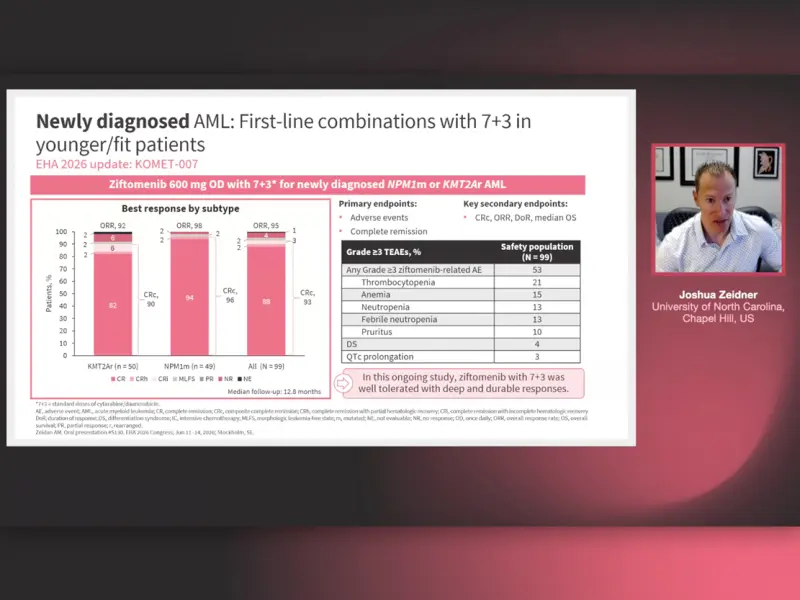
The AML Hub was pleased to speak with Eunice Wang, Roswell Park Comprehensive Cancer Center, Buffalo, US. We asked, What does the future hold for next-generation menin inhibition in AML?
What does the future hold for next-generation menin inhibition in AML?
During this interview, Wang discusses emerging strategies to optimize the efficacy of menin inhibitors for the treatment of acute myeloid leukemia (AML), including sequential treatment approaches to address acquired resistance, their integration into combination regimens for KMT2A-rearranged (KMT2Ar) or NPM1-mutated (NPM1m) AML, and their use alongside other targeted therapies for patients with co-occurring mutations.
Key points
- Two menin inhibitors are currently approved by the U.S. Food and Drug Administration (FDA): revumenib, for the treatment of relapsed/refractory (R/R) KMT2Ar acute leukemia or NPM1m AML; and ziftomenib, for the treatment of adults with R/R NPM1m AML.1,2
- Despite their clinical activity, response rates and durability remain limited, with median durations of response (DoR) of ~4–5 months.3,4
- Acquired resistance is also a challenge; menin inhibitor monotherapy has been associated with development of further mutations such as MEN1 mutations, which may impair menin inhibitor binding and affect the efficacy of treatment.5,6
- Several approaches involving menin inhibitors, including revumenib and ziftomenib, as well as next-generation therapies such as bleximenib and enzomenib, are under investigation to address these limitations and improve treatment outcomes for patients with KMT2Ar or NPM1m AML.
- One potential approach to address acquired resistance is sequential treatment with other menin inhibitors following loss of response, guided by the presence or absence of specific MEN1 mutations. Proof of concept for this strategy has been reported in clinical case studies, suggesting it may help overcome acquired resistance and restore responses.7,8
- Menin inhibitors are also being investigated in combination with intensive or non-intensive regimens for patients with newly diagnosed (ND) KMT2Ar or NPM1m AML, with early-phase studies reporting encouraging response rates.
- In the phase Ib ALE1002 trial (NCT05453903), bleximenib 100 mg BID plus intensive chemotherapy demonstrated a composite complete remission (CRc) rate of 87.5% in patients with ND KMT2Ar or NPM1m AML (N = 24).9
- In the phase I KOMET-007 trial (NCT05735184), ziftomenib + venetoclax + azacitidine demonstrated CRc rates of 28% and 48% in patients with R/R KMT2Ar (n = 32) and NPM1m (n = 48) AML, respectively.10
- An emerging approach is dual-targeted treatment for patients with co-occurring mutations. Clinical trials are investigating menin inhibitors in combination with FLT3 inhibitors, such as revumenib + gilteritinib (NCT06222580), and IDH inhibitors, such as ziftomenib + olutasidenib (NCT07411586), to target complementary disease pathways and potentially improve treatment efficacy.11,12
- Given their effects on chromatin regulation and gene expression, menin inhibitors are also being investigated beyond AML, with preclinical research exploring their potential in other acute leukemias such as B-cell and T-cell acute lymphoblastic leukemia.13,14
- The development of next-generation menin inhibitors and novel treatment strategies may help overcome current limitations of menin inhibitor therapy, improve outcomes for patients with AML, and potentially expand their application to a wider range of hematologic malignancies.
This educational resource is independently supported by Johnson & Johnson. All content is developed by SES in collaboration with an expert steering committee. Funders are allowed no influence.
References
- Revumenib. Prescribing Information (FDA). 2024. Revised Oct 2025.
- Ziftomenib. Prescribing Information (FDA). 2025. Revised Nov 2025.
- Arellano ML, Thirman MJ, DiPersio JF, et al. Menin inhibition with revumenib for NPM1-mutated relapsed or refractory acute myeloid leukemia: The AUGMENT-101 study. Blood. 2025;146(9):1065-1077. DOI: 10.1182/blood.2025028357
- Wang ES, Montesinos P, Foran J, et al. Ziftomenib in relapsed or refractory NPM1-mutated AML. J Clin Oncol. 2025;43(31):3381-3390. DOI: 10.1200/JCO-25-01694
- Issa GC, Cai SF, Bataller A, et al. Combination strategies with menin inhibitors for acute leukemia. Blood Cancer Discov. 2025;6(6):547-560. DOI: 10.1158/2643-3230.BCD-24-0212
- Perner F, Stein EM, Wenge, DV, et al. MEN1 mutations mediate clinical resistance to menin inhibition. Nature. 2023;615(7954):913-919. DOI: 10.1038/s41586-023-05755-9
- Chin K-K, Abdul-Hay M, Shukla M, et al. Overcoming MEN1-mediated resistance with menin inhibitor switching in KMT2A-rearranged acute myeloid leukemia. Leukemia. 2026;40:1331-1334. DOI: 10.1038/s41375-026-02959-6
- Desai AN, Mernar C, Herrera J, et al. Case report: Revumenib after prior menin inhibitor effective in KMT2A-rearranged acute myeloid leukemia (AML). Transplant Cell Ther. 2026;32(2):S410. DOI: 10.1016/j.jtct.2025.12.588
- Döhner H, Schuh AC, Recher C, et al. Bleximenib in combination with intensive chemotherapy: A phase 1b study in newly diagnosed acute myeloid leukemia with KMT2A or NPM1 iterations. Poster #5199. Presented at: 67th American Society of Hematology Annual Meeting and Exposition; Dec 6–9, 2025; Orlando, US.
- Issa GC, Fathi AT, Zeidan AM, et al. Ziftomenib in combination with venetoclax and azacitidine in relapsed/refractory NPM1-m or KMT2A-r acute myeloid leukemia: Updated phase 1a/b safety and clinical activity results from KOMET-007. Oral Abstract #764. Presented at: 67th American Society of Hematology Annual Meeting and Exposition; Dec 6–9, 2025; Orlando, US.
- ClinicalTrials.gov. SNDX-5613 and gilteritinib for the treatment of relapsed or refractory FLT3-mutated acute myeloid leukemia and concurrent MLL-rearrangement or NPM1 mutation. https://clinicaltrials.gov/study/NCT06222580. Updated May 14, 2026. Accessed Oct 21, 2026.
- ClinicalTrials.gov. Phase 1/1b trial of olutasidenib and ziftomenib for NPM1 and IDH1 co-mutated acute myeloid leukemia.https://clinicaltrials.gov/study/NCT07411586. Updated Aug 24, 2026. Accessed Oct 21, 2026.
- Shimamoto K, Karaoglu DA, Arnold O, et al. Targeting menin in T-lineage acute lymphoblastic leukemia. Mol Cancer Ther. 2026;25(8):1294-1304. DOI: 10.1158/1535-7163.MCT-25-0969
- Krivtsov AV, Evans K, Gadrey JY, et al. A menin-MLL inhibitor induces specific chromatin changes and eradicates disease in models of MLL-rearranged leukemia. Cancer Cell. 2019;36(6):660-673.e11. DOI: 10.1016/j.ccell.2019.11.001
Please indicate your level of agreement with the following statements:
The content was clear and easy to understand
The content addressed the learning objectives
The content was relevant to my practice
I will change my clinical practice as a result of this content
This content is accurate as of the date of publication and is not updated retrospectively. Please refer to the latest available evidence, guidelines, and relevant regulatory information when making clinical decisions.
Your opinion matters
Where do you see the greatest future value for NGS-based MRD assessment in AML/MDS?