All content on this site is intended for healthcare professionals only. By acknowledging this message and accessing the information on this website you are confirming that you are a healthcare professional. If you are a patient or carer, please visit Know AML.
The AML Hub website uses a third-party service provided by Google that dynamically translates web content. Translations are machine generated, so may not be an exact or complete translation, and the AML Hub cannot guarantee the accuracy of translated content. The AML Hub and its employees will not be liable for any direct, indirect, or consequential damages (even if foreseeable) resulting from use of the Google Translate feature. For further support with Google Translate, visit Google Translate Help.


The AML Hub is an independent medical education platform, sponsored by Daiichi Sankyo, Kura Oncology, Syndax, Abbvie, Thermo Fisher and Johnson & Johnson. Funders are allowed no direct influence on our content. The levels of sponsorship listed are reflective of the amount of funding given. View funders.
Now you can support HCPs in making informed decisions for their patients
Your contribution helps us continuously deliver expertly curated content to HCPs worldwide. You will also have the opportunity to make a content suggestion for consideration and receive updates on the impact contributions are making to our content.
Find out more
Create an account to access:
Bookmark & personalize site content
Receive alerts for new content in your areas of interest
View AML content recommended for you
Symposium | FLT3 mutations in AML: Types, prevalence, and clinical significance
Featured:
 Jorge Sierra
Do you know... How is newly diagnosed FLT3-ITD AML classified by the European Leukemia Network?
The AML Hub held a virtual symposium on November 19, 2025, titled, “Understanding the differences between FLT3-ITD and -TKD mutations in AML: Implications for clinical practice.” Here, we share a presentation by Jorge Sierra, Hospital de la Santa Creu i Sant Pau, Barcelona, ES, discussing the types, prevalence, and clinical significance of FLT3 mutations in acute myeloid leukemia (AML).
Symposium | FLT3 mutations in AML: Types, prevalence, and clinical significance
Symposium | FLT3 mutations in AML: Types, prevalence, and clinical significance
Sierra provided an overview of the role of FLT3-internal tandem duplication (ITD) and -tyrosine kinase domain (TKD) mutations in AML pathogenesis, and the differences in their molecular characteristics. He then discussed the prognostic value of FLT3-ITD and -TKD and concomitant mutations in patients with AML, and current risk stratification guidelines.
Key points
- Approximately one-third of patients with AML have FLT3-ITD or -TKD mutations.1–3
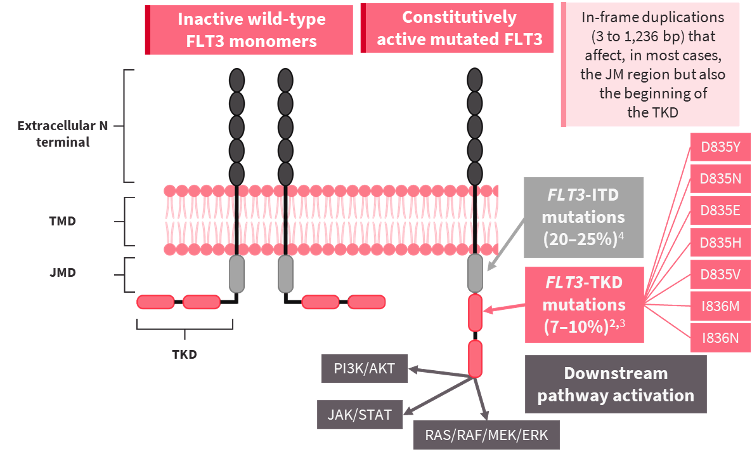
- FLT3-internal tandem duplications (ITD) in the juxtamembrane domain are present in 20–25% of AML cases,4 while mutations in the FLT3-tyrosine kinase domain occur in 7–10% of patients with AML (Figure 1).2,3
- FLT3 mutations result in constitutive activation of the FLT3 receptor and downstream pathways, leading to increased proliferation of leukemic cells.5
Figure 1. FLT3 signaling5
- FLT3 mutations are the most common type of genetic mutation in patients aged up to 65 years old and the seventh most prevalent in patients aged more than 65 years old.6,7
- The AMLSG BiO study confirmed that the prevalence of FLT3 mutations decreases with increasing age, with the highest rate (23%) in patients aged 45 years or younger.8
- It is important to assess the presence of concomitant mutations in patients with FLT3-mutated (FLT3m) AML, due to the potential prognostic impact.
- NPM1, DNMT3A, WT1, and CEBPA are the most commonly co-mutated genes in FLT3m AML.2
- A lower probability of survival has been demonstrated in patients with FLT3-ITD AML with NPM1 or DNMT3A co-mutations, vs those without FLT3-ITD (p = 0.009).6
- The prognostic value of FLT3-ITD measurable residual disease (MRD) has also been reported; the presence of FLT3-ITD MRD was associated with increased relapse incidence and reduced overall survival (OS) following two courses of induction chemotherapy in HOVON and CIBMTR studies,9,10 and prior to hematopoietic stem cell transplantation (HSCT) in an AMLSG study.11
- For patients fit for intensive therapy, the European Leukemia Network (ELN) 2022 risk classification defines FLT3-ITD at initial diagnosis as intermediate risk, regardless of NPM1 mutation status.12
- For patients receiving less intensive therapy, the ELN 2024 risk classification also defines FLT3-ITD as intermediate risk.13
- A meta-analysis revealed that the presence of FLT3-TKD alone does not have prognostic impact;14 however, the co-occurrence of FLT3-ITD and CBF or NPM1 mutations has been associated with favorable prognosis.15,16
- Re-evaluation of FLT3 mutation status at relapse is important; changes in FLT3 mutation status between diagnosis and relapse occur in 0.8–30.4% of patients with AML.17-25
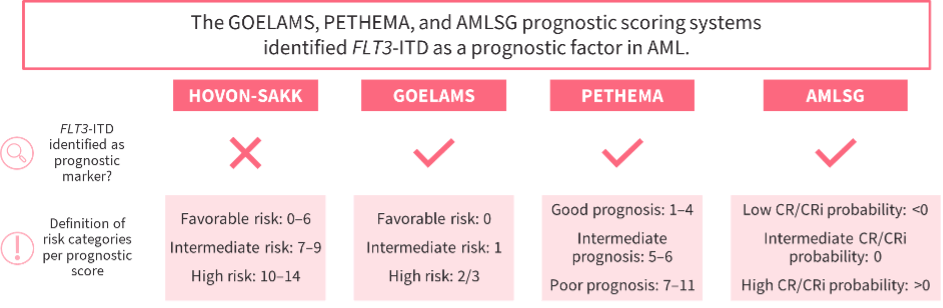
- FLT3-ITD has also been identified as a prognostic factor in relapsed/refractory AML (Figure 2).26
- Using data from the HOVON-SAKK studies, a revised prognostic model has been developed which integrates FLT3-ITD as a prognostic marker; this updated model provides OS risk stratification for patients in first relapse and may help guide second-line treatment decisions.27
Figure 2. FLT3-ITD as a prognostic factor in relapsed/refractory AML26
This educational resource is independently supported by Daiichi Sankyo. All content was developed by SES in collaboration with an expert steering committee. Funders were allowed no influence on the content of this resource.
References
Please indicate your level of agreement with the following statements:
The content was clear and easy to understand
The content addressed the learning objectives
The content was relevant to my practice
I will change my clinical practice as a result of this content
This content is accurate as of the date of publication and is not updated retrospectively. Please refer to the latest available evidence, guidelines, and relevant regulatory information when making clinical decisions.
More from this series: