All content on this site is intended for healthcare professionals only. By acknowledging this message and accessing the information on this website you are confirming that you are a healthcare professional. If you are a patient or carer, please visit Know AML.
The AML Hub website uses a third-party service provided by Google that dynamically translates web content. Translations are machine generated, so may not be an exact or complete translation, and the AML Hub cannot guarantee the accuracy of translated content. The AML Hub and its employees will not be liable for any direct, indirect, or consequential damages (even if foreseeable) resulting from use of the Google Translate feature. For further support with Google Translate, visit Google Translate Help.


The AML Hub is an independent medical education platform, sponsored by Daiichi Sankyo, Kura Oncology, Syndax, Abbvie, Thermo Fisher and Johnson & Johnson. Funders are allowed no direct influence on our content. The levels of sponsorship listed are reflective of the amount of funding given. View funders.
Now you can support HCPs in making informed decisions for their patients
Your contribution helps us continuously deliver expertly curated content to HCPs worldwide. You will also have the opportunity to make a content suggestion for consideration and receive updates on the impact contributions are making to our content.
Find out more
Create an account to access:
Bookmark & personalize site content
Receive alerts for new content in your areas of interest
View AML content recommended for you
Optimizing the allo-HSCT pathway for AML in the UK: A Delphi consensus study
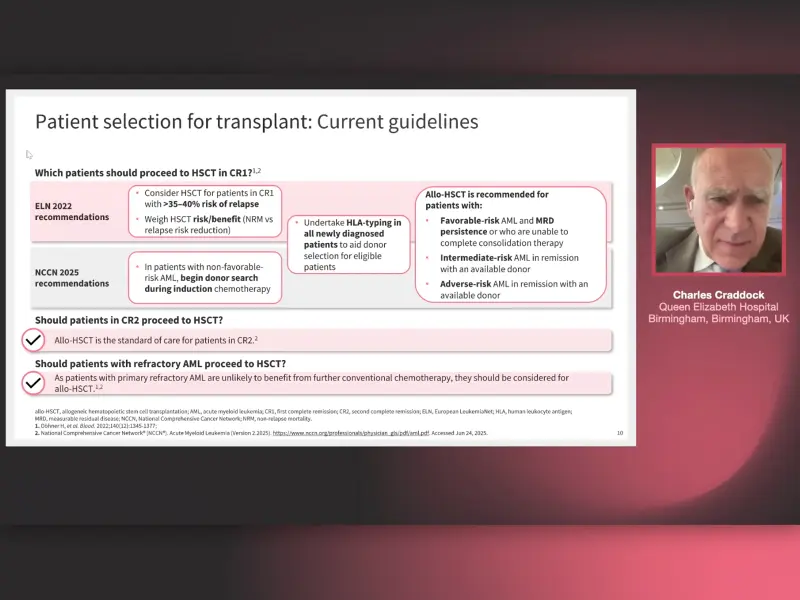
Results from a modified Delphi consensus study evaluating strategies to improve allogeneic hematopoietic stem cell transplantation (allo-HSCT) accessibility for adult patients with acute myeloid leukemia (AML) in the UK were published in eJHaem by Mehta et al. The aim of this study was to provide recommendations for streamlining and optimizing care and allo-HSCT pathways for patients with AML.
Key data: Consensus (≥75% agreement) was achieved across all 47 statements, with only four reaching <90% agreement. Nine key recommendations were developed based on the consensus-agreed statements: early transplantation discussions with patients at diagnosis; comprehensive assessment of patient eligibility for transplantation; consideration of transplantation for patients aged >60 years; integration of genetic and cytogenetic findings into patient case review; involvement of a regional multidisciplinary team (MDT); optimizing timing of transplantation (ideally in first complete remission [CR1], or in CR2 if not feasible in CR1); ensuring documentation and accountability when delays occur; post-transplantation planning; and standardization of communication protocols between referring hospitals, transplantation centers, and patients, to improve allo-HSCT accessibility across the UK.
Key learning: Strong expert consensus was achieved across statements, supporting the development of actionable recommendations to minimize delays to transplantation, strengthen communication between the MDT and patients, and optimize care pathways and accessibility for transplant-eligible patients with AML.
References
Please indicate your level of agreement with the following statements:
The content was clear and easy to understand
The content addressed the learning objectives
The content was relevant to my practice
I will change my clinical practice as a result of this content

 (1).jpeg)