All content on this site is intended for healthcare professionals only. By acknowledging this message and accessing the information on this website you are confirming that you are a healthcare professional. If you are a patient or carer, please visit Know AML.
The AML Hub website uses a third-party service provided by Google that dynamically translates web content. Translations are machine generated, so may not be an exact or complete translation, and the AML Hub cannot guarantee the accuracy of translated content. The AML Hub and its employees will not be liable for any direct, indirect, or consequential damages (even if foreseeable) resulting from use of the Google Translate feature. For further support with Google Translate, visit Google Translate Help.


The AML Hub is an independent medical education platform, sponsored by Daiichi Sankyo, Kura Oncology, Syndax, Abbvie, Thermo Fisher and Johnson & Johnson. Funders are allowed no direct influence on our content. The levels of sponsorship listed are reflective of the amount of funding given. View funders.
Now you can support HCPs in making informed decisions for their patients
Your contribution helps us continuously deliver expertly curated content to HCPs worldwide. You will also have the opportunity to make a content suggestion for consideration and receive updates on the impact contributions are making to our content.
Find out more
Create an account to access:
Bookmark & personalize site content
Receive alerts for new content in your areas of interest
View AML content recommended for you
ASH 2025 | PARADIGM: Azacitidine + venetoclax vs conventional induction chemotherapy in fit adults with ND AML
Featured:
 Amir Fathi
Do you know... In fit patients with newly diagnosed AML treated with azacitidine + venetoclax in the PARADIGM trial, what was the median EFS?
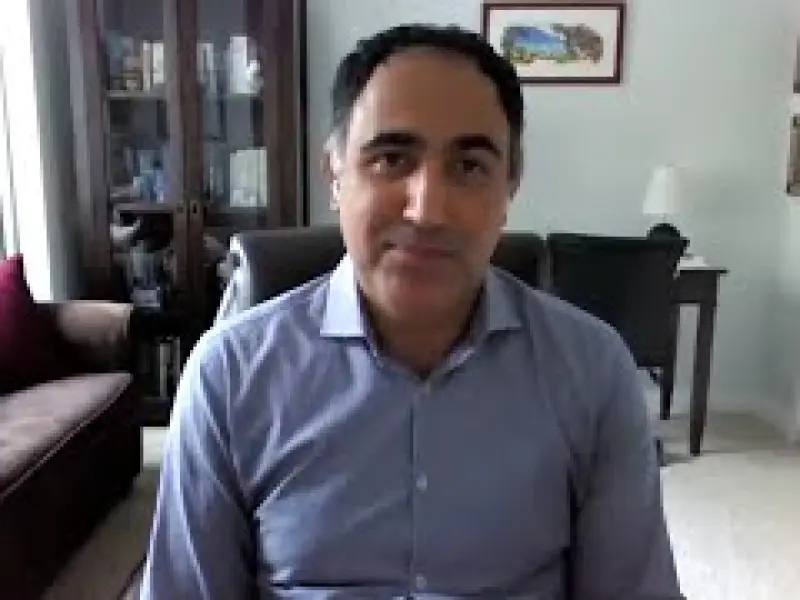
Following the 67th American Society of Hematology (ASH) Annual Meeting and Exposition, December 6–9, 2025, Orlando, US, the AML Hub was pleased to speak with Amir Fathi, Massachusetts General Hospital, Boston, US. We asked, How might the phase II PARADIGM trial data impact treatment decisions for newly diagnosed fit adults with acute myeloid leukemia (AML)?
ASH 2025 | PARADIGM: Azacitidine + venetoclax vs conventional induction in fit adults with ND AML
ASH 2025 | PARADIGM: Azacitidine + venetoclax vs conventional induction in fit adults with ND AML
In this interview, Fathi discussed key findings from the open-label, randomized, phase II PARADIGM trial comparing azacitidine (Aza) + venetoclax (Ven) with conventional induction chemotherapy (IC) in functionally fit patients with newly diagnosed AML (NCT04801797). The trial’s primary endpoint was event-free survival (EFS).
Key points
- Patients aged ≥18 years with newly diagnosed AML who were eligible for IC were randomized to receive Aza + Ven (n = 86) or IC (7+3 regimen or liposomal daunorubicin and cytarabine [CPX351]; n = 86).
- Patients meeting the following criteria were excluded from the trial: t(15;17); acute promyelocytic leukemia; core binding factor alterations; FLT3 mutations; NPM1 mutations (in patients aged <60 years); BCR::ABL1 fusion; or mixed phenotype AML.
- At a median follow up of 21.9 months, the median EFS was 14.6 months with Aza + Ven vs 6.15 months with IC (p = 0.0021). The 1-year EFS was 53.4% with Aza + Ven vs 36.0% with IC.
- The median overall survival was 21.5 months vs 18.6 months with Aza + Ven vs IC (p = 0.1873).
- Adverse events were primarily hematologic and occurred at similar rates between arms.
- Compared with Aza + Ven, higher proportions of patients receiving IC experienced Grade ≥3 treatment-emergent infectious (20.8% vs 15.1%; p = 0.04) and bleeding (6.3% vs 1.3%; p = 0.01) adverse events.
- A greater proportion of patients treated with Aza + Ven proceeded to transplant than with IC (p = 0.009).
- The trial’s primary endpoint was met; data demonstrate improved EFS with Aza + Ven vs IC in functionally fit patients with newly diagnosed AML.
- Furthermore, patient-reported outcomes indicate that Aza + Ven improved quality of life, depression symptoms, and symptom burden, and was associated with reduced healthcare utilization.
- Together, findings support the use of Aza + Ven in this patient population.
This educational resource is independently supported by AbbVie. All content was developed by SES in collaboration with an expert steering committee. Funders were allowed no influence on the content of this resource.
References
Please indicate your level of agreement with the following statements:
The content was clear and easy to understand
The content addressed the learning objectives
The content was relevant to my practice
I will change my clinical practice as a result of this content
This content is accurate as of the date of publication and is not updated retrospectively. Please refer to the latest available evidence, guidelines, and relevant regulatory information when making clinical decisions.